
Basement Flooring Options in Utah: What Works Below Grade
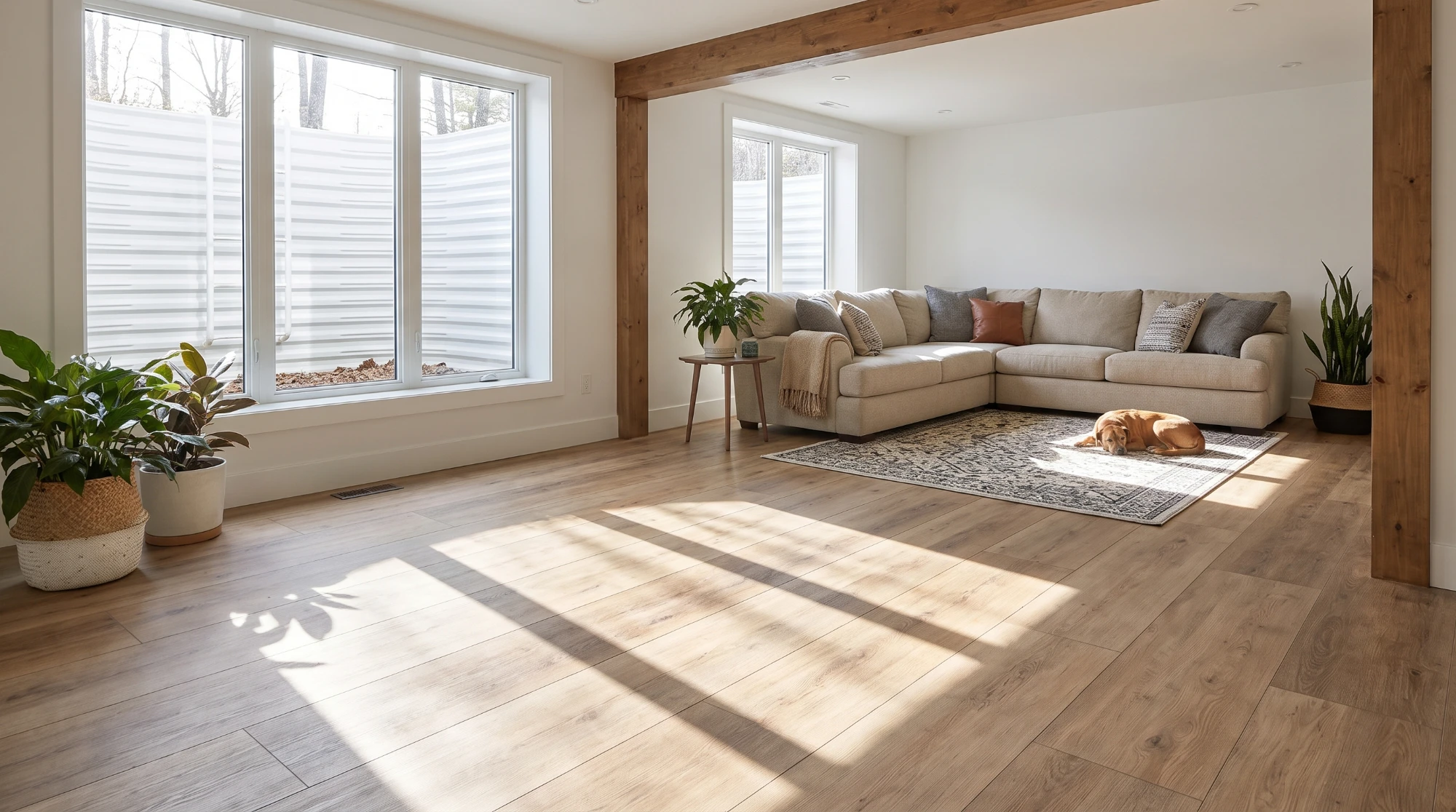
A basement floor has a harder job than the floor upstairs. It sits on a concrete slab that's cooler than the room, can release moisture for years, and may be a few inches from the soil on the other side of the wall. The best flooring is the one the slab can support and your use can survive.
Start with the slab
Pick the floor after you know what the slab is doing:
- Test for moisture first. A taped plastic sheet is a quick screen. A measured test is what most flooring makers want before they'll warrant a floor: the calcium chloride test (ASTM F1869) or the in-slab relative humidity probe (ASTM F2170). The limit depends on the product, so check the maker's installation instructions. See basement moisture before finishing.
- Check flatness. Most floating and glued floors have a flatness limit, and a slab that dips needs leveling first.
- Fix the source. A floor over a slab with a water problem fails no matter what it is. Drainage, grading and window wells come first.
- Count the height. Every flooring system takes height from the ceiling. A raised subfloor adds more than a thin plank. Measure after the floor is in (2021 IRC R305 sets 7 feet for living space). See basement ceiling options in Utah.
The main options
Luxury vinyl plank (LVP) and rigid-core vinyl. The most common basement choice. The planks aren't harmed by water, so a spill or a leak doesn't ruin them, and many click together and float over a clean, flat slab. Watch for: a waterproof plank doesn't make the whole floor assembly waterproof. Moisture can still collect under it, and many makers set a moisture limit for the slab. Floating floors also need a gap at the walls.
Engineered hardwood. Real wood with a layered core, made to be more stable than solid planks. NWFA guidance, as quoted in manufacturers' installation instructions, treats solid hardwood as suitable above and on grade but not below grade, and engineered wood as an option below grade. Watch for: it's not waterproof, the maker has to approve it for below-grade use, and it needs a slab that meets the maker's moisture limits.
Porcelain or ceramic tile. Handles water and wear, and suits bathrooms, laundry and wet bars. It can be paired with in-floor heat. Watch for: it's cold and hard without heat, a slab with cracks can crack the tile, and grout needs sealing.
Carpet and carpet tile. The warmest and quietest underfoot, and a good choice for a bedroom or a play area. Carpet tile lets you replace one square after a spill. Watch for: carpet and its pad hold moisture and smells, so it works best over a slab that's tested dry, with a pad made for below grade.
Laminate. Often cheaper, with a hard top layer. Watch for: most laminate has a fiberboard core that swells if it gets wet, and the edges are the weak point. Some are sold as water-resistant. Read the maker's below-grade rules before choosing it.
Stained, polished or sealed concrete. The floor is already there. It's durable and it keeps all the height. Watch for: cracks and stains show, it's cold and hard, and a sealer has to suit a slab that's breathing moisture.
Epoxy coating. A tough, easy-clean surface for a workshop, a gym or a utility room. Watch for: it needs a well-prepared slab, and moisture vapor coming up through the concrete can cause bubbling or peeling.
Rubber flooring. Made for gyms and play areas. It absorbs impact and noise. Watch for: it has an odor when new, and it's not meant for a whole living area.
Match the floor to the room
- Family or rec room: LVP, engineered wood or carpet. Be careful with solid wood and thin laminate.
- Bedroom: carpet, carpet tile or LVP. Cold concrete needs a rug.
- Bathroom or laundry: tile or vinyl. Be careful with carpet and laminate.
- Wet bar or kitchenette: tile or vinyl. Be careful with laminate and hardwood.
- Gym: rubber, or LVP over a firm base. Be careful with tile, and with floating floors under heavy weights.
- Workshop or storage: sealed concrete or epoxy. Be careful with carpet.
What goes under it
A raised or dimpled subfloor, or a vapor-control layer made for the flooring, sits between the slab and the floor. It adds a little height and some warmth, and it gives moisture room to move, but it doesn't fix a wet slab. Ask whether the flooring maker requires one, and which kind they approve.
Warmth and sound
Utah basements are cold in winter. Carpet and carpet tile feel warmest. Hard floors feel better with an area rug, and in-floor heating can go under tile, and under some other floors if the maker approves it. Sound comes down from the room above and travels out of a hard-floored room, so ask about underlayment, and plan insulation in the joist bays.
What drives the cost
PANDEN bids from a walkthrough, not a price per square foot. For flooring, what moves the number most:
- how much slab preparation is needed, such as leveling or crack repair
- whether a subfloor or vapor-control layer is required
- the material you pick
- the size of the area and how many rooms it's cut into
- stairs, transitions and trim
- tile, heat or other layers in wet rooms
Where to start
Test the slab, fix any moisture source, and measure your height. Then choose the floor for each room. PANDEN does this on the first walkthrough, looking at the slab, the windows and the ceiling height before it prices the work. See the local steps for Lehi, Saratoga Springs, Herriman and South Jordan, or see how to finish a basement for the order of the work.
Frequently asked questions
What's the best flooring for a basement?
For most family rooms, vinyl plank or engineered hardwood, as long as the slab tests within the maker's limits. Tile suits bathrooms and wet areas.
Can I put hardwood in a basement?
Solid hardwood isn't recommended below grade under NWFA guidance. Engineered hardwood can work if the maker approves it for below grade and the slab is dry.
Is vinyl plank really waterproof?
The planks are, but the floor system isn't. Water or moisture can collect underneath, and the maker may require a moisture limit or a vapor-control layer.
Do I need a subfloor?
Sometimes. A raised or dimpled subfloor is common under wood and some other floors. Check the flooring maker's instructions for your product.
Can I put carpet in a basement?
Yes, in a basement that has tested dry, with a pad made for below grade. Carpet tile is easier to repair.
Can I leave the concrete exposed?
Yes. Sealed or stained concrete is durable, but cracks and stains show and it's cold underfoot.
Does flooring change my ceiling height?
Yes. A thicker floor or a raised subfloor takes height from the ceiling, so measure after the floor goes in.
Sources: ASTM F1869 and F2170 (concrete moisture test methods) and ASTM F710 (preparing concrete floors for resilient flooring); National Wood Flooring Association installation guidelines, as quoted in flooring manufacturers' instructions; 2021 International Residential Code R305 (ceiling height), as adopted in Utah.