
Basement Moisture Before Finishing in Utah: Test First, Then Build
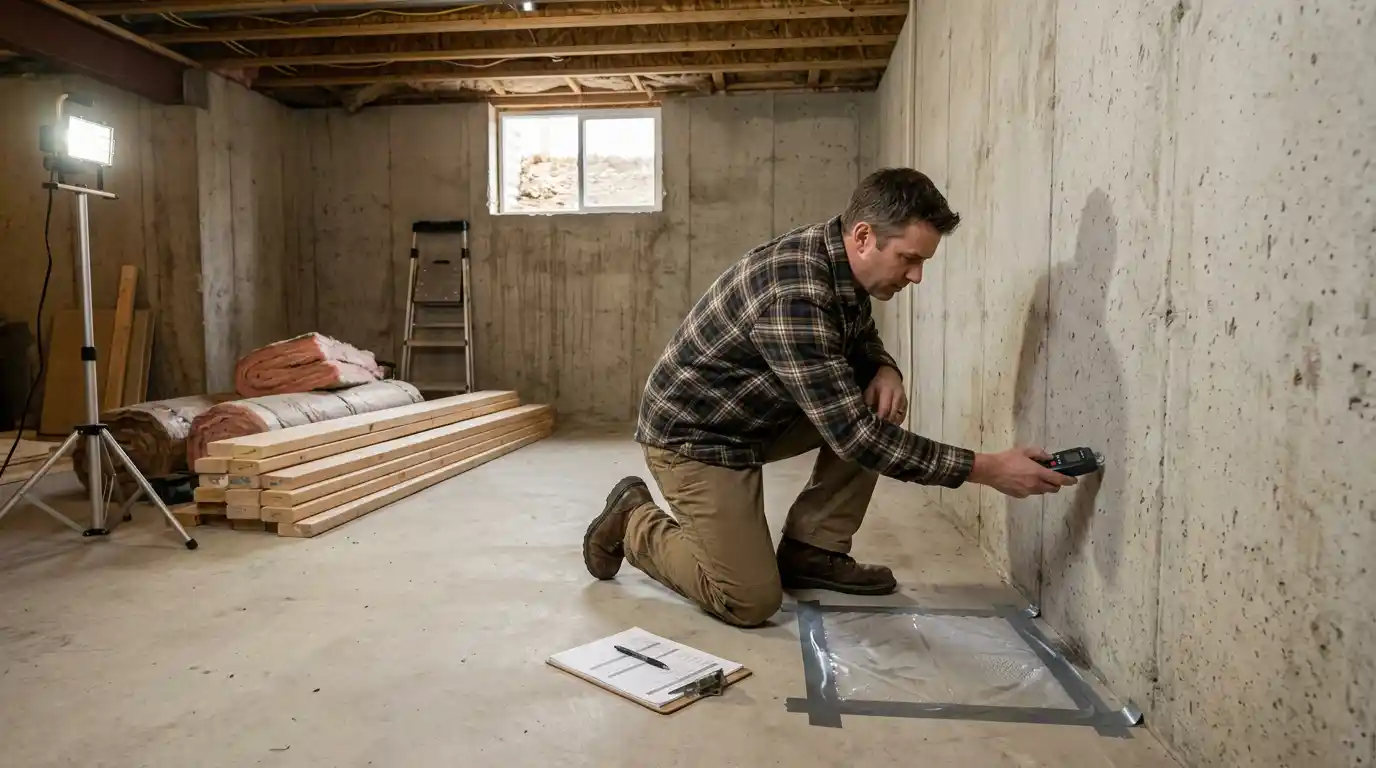
Finishing a damp basement doesn't fix the dampness. It hides it behind drywall and flooring, where it turns into mold, warped trim and a smell you can't trace. In Utah the sequence that works is simple: test, fix the cause, then finish.
Why Wasatch Front basements get damp
Most basement moisture comes from three places: water in the soil pressing on the foundation, surface water running toward the house, and humid air condensing on cool concrete.
Groundwater is the one people underestimate here. The Utah Geological Survey defines shallow groundwater as a water table within 20 feet of the surface, and says water levels rise during heavy rain, snowmelt and surface flooding, which causes foundation and basement problems. A U.S. Geological Survey study of the Salt Lake Valley found that in about half of the valley the shallow aquifer sits less than 10 feet below the surface, and that it can flood basements. Utah's snowmelt season makes spring the riskiest time.
It also varies a lot from street to street. A home near Utah Lake in Saratoga Springs is in a different situation from one on a bench in Lehi, which is why Saratoga Springs requires a walkout drain inspection for basement permits.
Signs your basement has a moisture problem
- A musty smell, especially after rain or snowmelt
- White, chalky residue on concrete or block walls (called efflorescence)
- Damp patches on the slab, or dark staining at the base of walls
- Condensation on cold pipes and windows
- Peeling paint or bubbling finishes on the lower wall
None of these means the basement can't be finished. They mean find the source first.
Three tests you can do before calling anyone
1. Check the humidity. The EPA recommends keeping indoor relative humidity below 60 percent, ideally between 30 and 50 percent, and notes that mold can grow on organic surfaces above 60 percent. A basic humidity meter costs little and is sold at hardware stores. Read it for a few days, not once.
2. The plastic sheet test. Tape an 18-inch square of clear plastic to the concrete floor, sealed on all edges, and leave it for at least 24 hours. This is the plastic sheet method (ASTM D4263). Droplets or darkening underneath mean moisture is coming up through the slab. It's a quick screen, and it depends on temperature, so a clean result doesn't prove the slab is dry.
3. Watch after a storm. Check the walls and the floor edges within a day of heavy rain or a big melt. Water that appears only then points to drainage or grading outside, not the slab.
When to test properly
If a flooring manufacturer will warrant their product on your slab, they will usually require a measured test, not a screen. The two common ones are the calcium chloride test (ASTM F1869), which measures moisture vapor coming off the slab over 60 to 72 hours, and the in-slab relative humidity probe (ASTM F2170), which measures humidity inside the concrete. The acceptable limit depends on the product, so check the flooring maker's own instructions.
Fix the cause before you finish
Work from the outside in:
- Grading and gutters. The ground should slope away from the foundation, and downspouts should discharge well away from the house.
- Window wells. A well that fills with water becomes a direct path into the basement. Wells need drainage, and covers help in winter.
- Foundation drainage. For new construction, the 2021 International Residential Code (adopted in Utah) requires drains around foundations that enclose habitable or usable space below grade (R405). Where a high water table or severe soil-water conditions are known, exterior walls must be waterproofed, not just dampproofed (R406). Older homes were built to older rules, which is why some need an interior drain or sump added.
- Interior drain and sump. The Utah Geological Survey lists a sump system, which collects water under or beside the slab and pumps it away, as a standard mitigation for groundwater problems.
- Humidity. If the air is the issue, a dehumidifier sized to the space, plus proper ventilation, brings it into the 30 to 50 percent range.
Finish it in a way that tolerates moisture
Even a well-sealed basement sees seasonal swings. Choices that help: a moisture-tolerant floor system such as vinyl plank over a dimpled or raised subfloor rather than carpet glued to the slab, water-resistant materials at the base of the walls, and leaving access to the spots where plumbing and the sump enter the floor. Framing and insulation details matter too, and they're best planned with the moisture source known.
Test for radon at the same time
Radon collects in basements, and the work you do to deal with moisture (sealing the slab, sump covers) is easier to coordinate with radon mitigation while the walls are open. The Utah Radon Program reports that about 1 in 3 Utah homes has elevated radon: 37 percent of 60,000 tests came back above the EPA action level of 4 pCi/L. Low-cost test kits are available at radon.utah.gov.
What we look at on a walkthrough
When PANDEN walks a basement before quoting, we look at the slab and wall bases, window wells, the grading outside, and where plumbing comes through, so a moisture problem is raised before the walls go up, not after. See how this plays out city by city: Lehi, Saratoga Springs, Herriman and South Jordan.
Frequently asked questions
Can I finish a basement that has had water in it?
Often yes, but only after the source is found and fixed, and the space is dry and testing within normal humidity.
Is a dehumidifier enough?
It treats damp air, not water coming through the wall or slab. Test first to know which problem you have.
What humidity should a finished basement stay at?
The EPA's guidance is below 60 percent, ideally 30 to 50 percent.
Does spring snowmelt make it worse?
It can. The Utah Geological Survey notes groundwater rises with rain, snowmelt and surface flooding, so test or inspect at that time of year if you can.
Do I need a permit to finish after waterproofing work?
Interior and exterior drainage work and the finish itself can each need one. Check with your city's building department, and see our city pages for the local steps.
Sources: Utah Geological Survey, shallow groundwater and groundwater flooding guidance; U.S. Geological Survey, Reconnaissance of the shallow-unconfined aquifer in Salt Lake Valley; U.S. EPA, A Brief Guide to Mold, Moisture and Your Home; 2021 International Residential Code, R405 and R406 (as adopted in Utah); ASTM D4263, F1869 and F2170 concrete moisture test methods; Utah Radon Program.