
How to Choose a Basement Contractor in Utah
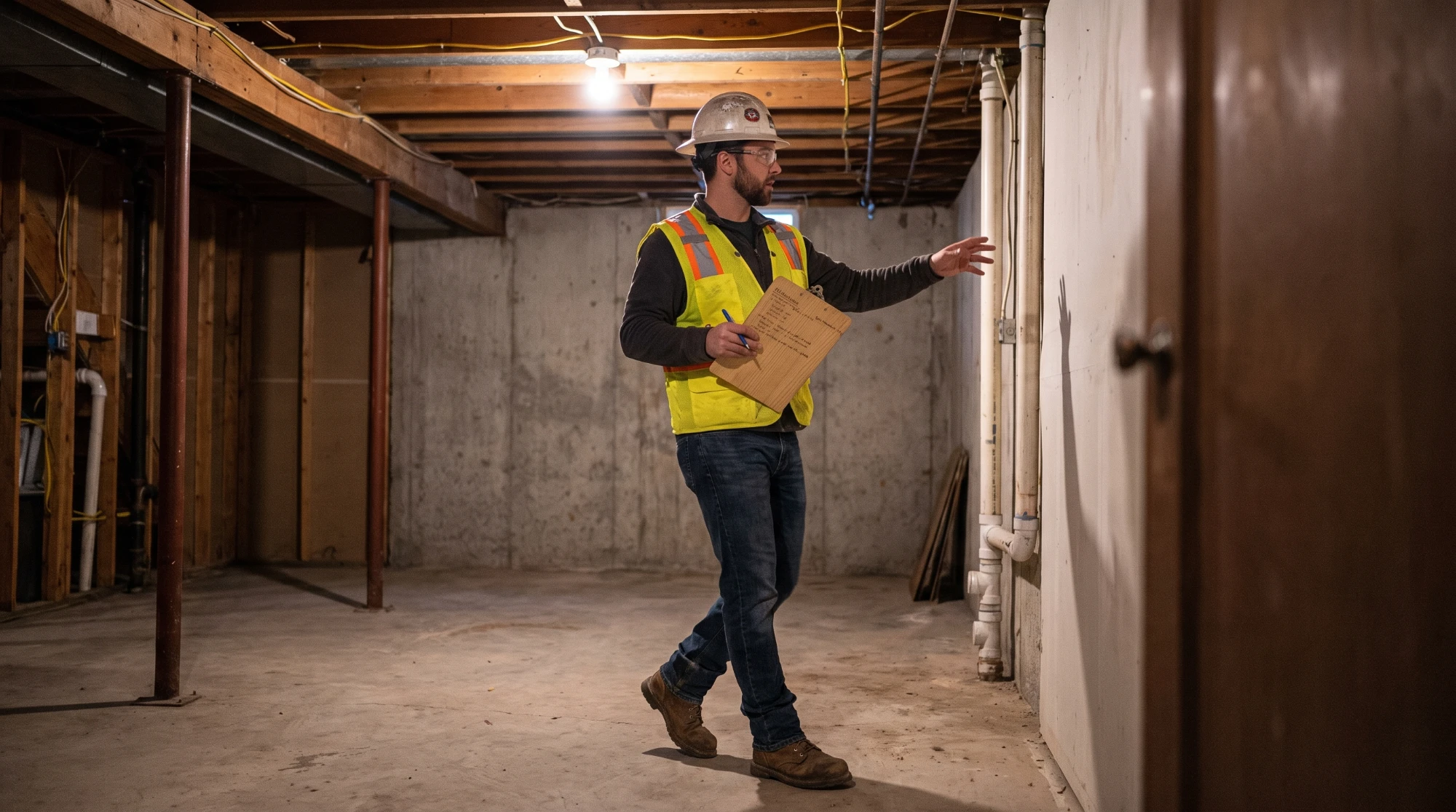
Choose a basement contractor by checking three things before you compare bids: that the license is active, that the insurance is current, and that the scope is in writing. Everything else, the personality, the portfolio and the price, matters only after those hold. This guide walks through what to check, what to ask, and what to watch for.
1. Check the license
Utah licenses contractors through the Division of Professional Licensing (DOPL), part of the Utah Department of Commerce. DOPL has a free "Verify a License" search, and a separate search for disciplinary actions and citations. Look up the contractor by name or license number and confirm three things:
- The license is active. An inactive license doesn't count.
- The classification fits the work. DOPL's general contractor classifications are B100, E100 and R100, and there are separate specialty licenses. If you're not sure which one covers your project, DOPL's contracting line is (801) 530-6628.
- There's no discipline history you'd care about. Check the disciplinary actions search.
A small job can fall under an exemption from licensing, but a basement finish with framing, electrical, plumbing and a permit isn't a small job. Ask DOPL if you're unsure.
2. Ask for proof of insurance
Utah law requires every active contractor license to maintain general liability insurance. DOPL's minimums are $1 million per occurrence and $2 million in total, effective April 20, 2026. Ask for the certificate of insurance and check that it's current.
Ask about workers' compensation too. Employers must cover their employees with workers' compensation, so ask how the contractor's own crew and any subcontractors are covered. If someone is hurt on your property, that answer decides who pays.
3. Know how liens work
A contractor who doesn't pay a subcontractor or a supplier can leave you facing a lien on your home, so Utah's Residence Lien Restriction and Lien Recovery Fund Act gives homeowners a defense. To qualify, DOPL says you must:
- sign a written contract with a contractor who was licensed (or exempt) when you signed it
- pay the original contractor in full under the contract and any changes to it
- have the home occupied as a primary or secondary residence within 180 days of completion
If you meet those conditions, you can apply to DOPL for a Certificate of Compliance. The practical takeaway: get a written contract, keep a record of every payment, and keep a copy of the contractor's license and insurance. If a lien or a lawsuit ever arrives, those records are your proof. The act covers single-family and duplex homes.
4. Get the scope in writing
DOPL offers an optional Residential Construction Agreement for homeowners and contractors, with exhibits for the project plans, a change order form, and proof of license and insurance. You don't have to use that form, but a good contract covers the same ground:
- What's included, and what isn't. Exclusions matter as much as inclusions.
- Who pulls the permit, who pays for it, and who schedules the inspections.
- Allowances. Flooring, fixtures, lighting and cabinets are often priced as allowances. Know the amount and what happens if you choose something more expensive.
- Change orders. How changes are priced and approved before the work, not after.
- Payment schedule. Payments tied to finished stages of work, not dates on a calendar.
- Schedule and start date, and what could delay them.
- Warranty, in writing, with what it covers and for how long.
5. Compare bids the right way
Two bids that look similar can cover different work. Line them up on the same items:
- Egress. Does the plan include a new window and well for every bedroom?
- Ceiling. Drywall, drop ceiling, soffits around ducts? See basement ceiling options in Utah.
- Moisture and radon. Is testing included, and what happens if a problem turns up? See basement moisture before finishing.
- Plumbing and electrical. Is a bathroom, a wet bar or a panel upgrade in or out?
- Heating and cooling. Does the plan check whether the system can serve the new space?
- Flooring prep. Is slab testing and preparation included? See basement flooring options in Utah.
- Permits and inspections. Included, or on you?
An itemized bid makes this easy. A single lump sum doesn't. A big gap between bids usually means one of them leaves something out, and the cheapest number isn't always the cheapest basement.
6. Ask these questions
- What's your Utah license number, and what classification is it?
- Can I see the certificate of insurance?
- Who pulls the permit and schedules the inspections?
- Who will be on site, and are they your employees or subcontractors?
- What's included in the bid, and what isn't?
- What allowances are in the price?
- How do you handle a change after we've signed?
- What's the payment schedule?
- How will you handle moisture or a surprise, such as a crack or a wet wall, once the walls are open?
- How long will the work take, and what could change that?
- What does the warranty cover, and for how long?
- Can I talk to a recent customer in my city?
7. Know the red flags
- No license number, or a license that doesn't check out
- No certificate of insurance, or one that's expired
- No written contract, or one that's vague about scope
- A large payment before any work has started
- No itemized bid, only a lump sum
- Pressure to sign today
- A refusal to pull a permit, or advice to skip one
- No references in your area
8. Keep the paperwork
At the end, keep the contract, any change orders, the permit and inspection approvals, the product warranties and photos of work that's hidden behind drywall. They matter for repairs, for insurance and when you sell. You'll also want them if a lien question ever comes up.
How PANDEN works
PANDEN is based in Lehi. Every project starts with a walkthrough: we look at the space, the windows, the ductwork, the plumbing rough-ins and the electrical panel. You get an itemized bid, often within 24 to 48 hours, and we prepare the plans, submit the permit and schedule the inspections. You can check us the same way you'd check anyone else, through DOPL's license search. See the local steps for Lehi, Saratoga Springs, Herriman and South Jordan, or how to finish a basement for the order of the work.
Frequently asked questions
How do I check a Utah contractor's license?
Use the Verify a License search on the Division of Professional Licensing's website. Check that the license is active, that the classification fits your work, and look at the disciplinary actions search.
Does a basement contractor need to be licensed in Utah?
Yes, for a project of this size. A small job can fall under an exemption, but a finished basement with a permit isn't one. Ask DOPL if you're not sure.
What insurance should a contractor have?
General liability is required for every active license in Utah, and DOPL's minimums are $1 million per occurrence and $2 million in total. Ask for the certificate, and ask about workers' compensation too.
Should I pay a deposit?
Many contractors ask for one. Ask what it covers and when each later payment is due, and tie payments to finished stages of the work, all in a written contract.
What is a mechanics' lien, and how do I avoid one?
It's a claim against your property by someone who wasn't paid for work or materials. Utah gives homeowners a defense if they have a written contract with a licensed contractor, pay in full, and occupy the home within 180 days of completion.
Is the lowest bid the best choice?
Not by itself. Compare what each bid includes. A low bid that leaves out egress, permits or moisture work will cost you later.
Who is responsible for the permit?
It should be written in the contract. PANDEN handles the city permit for its projects.
Sources: Utah Division of Professional Licensing (DOPL), contracting pages and frequently asked questions, including license verification, general liability and insurance minimums, and the optional Residential Construction Agreement; Utah Department of Commerce, Residence Lien Recovery Fund pages and frequently asked questions; Utah Residence Lien Restriction and Lien Recovery Fund Act.