
Utah ADU Zoning and Permits: Internal vs. Detached Rules, and What Changed in 2026
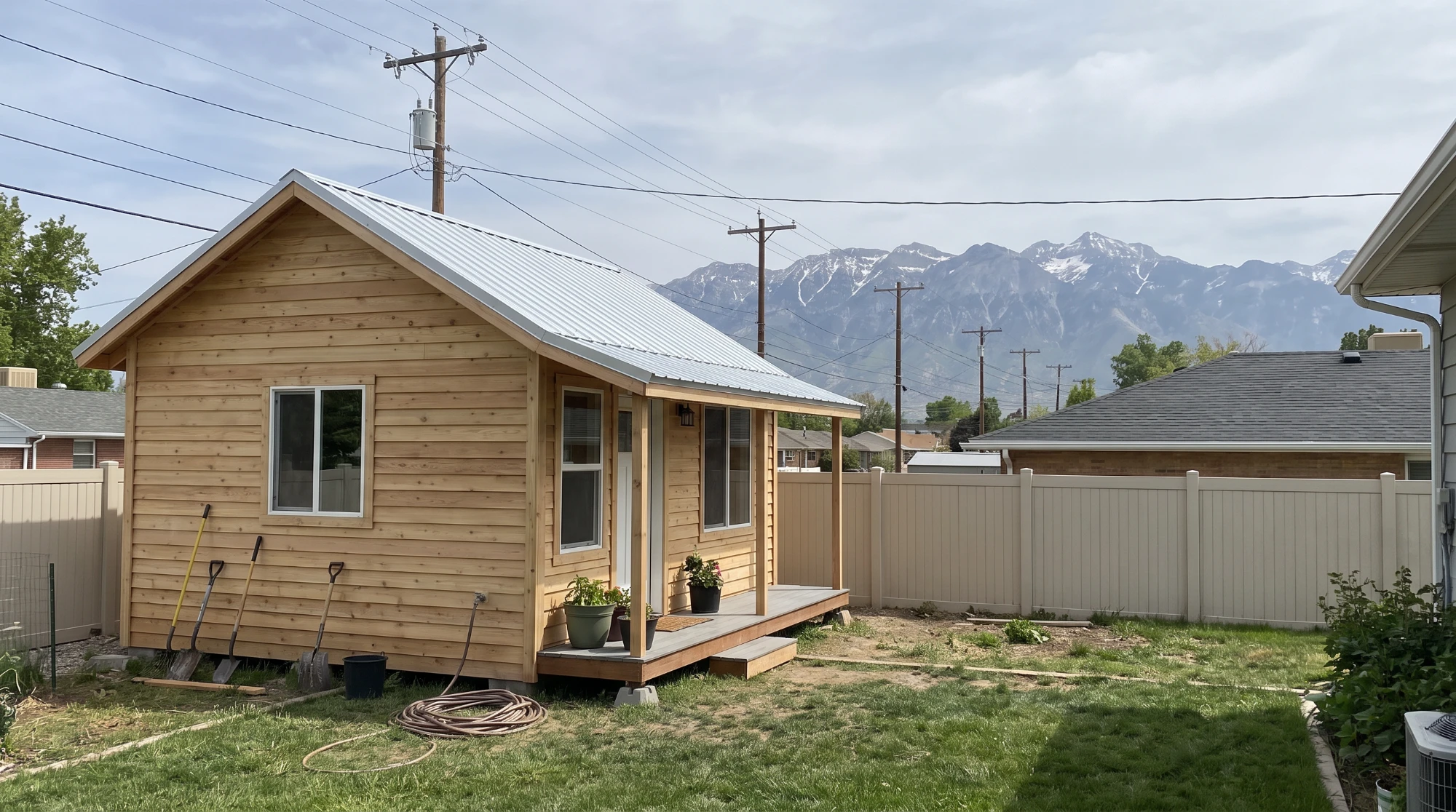
An accessory dwelling unit (ADU) is a second, self-contained home on a lot that already has a house. In Utah, state law treats two kinds very differently: an internal ADU, built inside the existing home (a basement apartment is the usual example), and a detached ADU, a separate building in the yard. The internal rules have been settled since 2021. The detached rules are new: a 2026 law took effect on October 1, 2026.
The two kinds of ADU, side by side
Internal ADU
- Where: inside the primary home, within its existing footprint
- State law: Utah Code 10-21-303
- Permitted use: yes, in areas zoned primarily for residential use
- Minimum rental: 30 consecutive days (cities may require it)
- Owner: cities may bar renting if the owner doesn't live in the home
Detached ADU
- Where: a separate building on the lot
- State law: Utah Code 10-21-304, effective October 1, 2026
- Permitted use: yes, on lots of 11,000 square feet or more in covered cities
- Minimum rental: cities may prohibit rentals under 90 consecutive days
- Owner: cities may require the owner to live in the house or the ADU
Internal ADUs: the 2021 rules
Under Utah Code 10-21-303, an internal ADU is a permitted use in any area zoned primarily for residential use. It's created within a primary dwelling, within that home's footprint, for long-term rental of 30 days or more. The primary dwelling is a detached single-family home that's the owner's primary residence.
A city can't restrict the unit's size relative to the home, the lot size, street frontage or internal connectivity. The unit must comply with building, health and fire codes. A city may still require one extra on-site parking space (unless it already requires four), prohibit a separate utility meter, require a permit or license to rent, bar the unit on lots of 6,000 square feet or less, bar rentals under 30 days, and bar renting if the owner doesn't live there. For the full list and the building-code details, see our guide to mother-in-law suites in Utah.
Detached ADUs: what the 2026 law requires
Utah Code 10-21-304, passed in the 2026 General Session as S.B. 284, requires a "specified municipality" to adopt a land use regulation that permits a detached ADU on any lot of 11,000 square feet or more that contains a single-family home. Cities may also allow them on smaller lots.
Which cities are covered. "Specified municipality" means any city of the first, second, third or fourth class, or a fifth-class city with a population of 5,000 or more in a county of the first, second or third class. That covers most Wasatch Front cities. Check with yours.
What the city must do. Its regulation must require the unit to meet building, health and fire codes, and must include a process for converting a legally built accessory structure into a detached ADU, subject to setbacks and the same codes.
What the city may not do.
- require a conditional use permit in a primarily residential zone
- require more than two on-site parking spaces for a detached ADU of 650 square feet or larger, or more than one for a smaller unit
- apply design standards that conflict with state law on single-family design
What the city may still do. A city may:
- require the unit to follow its rules on structure size, dimensions, height, maximum lot coverage and setbacks (setbacks can account for property lines, other structures, easements, window orientation and massing)
- require the unit to be designed consistent with the main house
- prohibit a unit that's larger than the house, sits in a utility or recorded easement, sits in the front yard, or is rented for less than 90 consecutive days
- require the owner to live in the house or in the ADU
- require parking replaced when a detached garage is converted
- allow only one ADU per lot
- prohibit a unit that can't get adequate utility service, or whose connection point lacks capacity
The law doesn't override a development agreement signed on or before May 6, 2026, so some subdivisions can still prohibit detached ADUs.
How a few of our cities handle it
City ordinances were being updated around the October 1 deadline, so confirm the current text before you plan.
- Herriman. Herriman's detached ADU page lists the Residential or Agricultural zones, a lot of at least 0.2295 acres (about 10,000 square feet), and one ADU per lot, internal or detached. The owner must live in the main house or the ADU. The unit can be rented only after the approval letter and a business license. The application asks for a site plan with setbacks, construction plans, a gas line diagram, energy efficiency documents and Manual J and S load calculations. The city's plan review is typically 7 to 14 business days. See our Herriman page.
- Lehi. As reported by the Daily Herald in July 2026, Lehi already allowed detached ADUs on lots of at least 14,520 square feet, and its council approved a new policy requiring a 6-foot separation from the main home and owner occupancy of either unit. See our Lehi page.
- Saratoga Springs. The city published a notice of a citywide amendment to its accessory unit chapter (19.20) to add detached ADU rules in line with the state law. See our Saratoga Springs page.
- South Jordan. South Jordan keeps its ADU rules in Chapter 17.130 of its code and amended them in 2026. See our South Jordan page.
- Salt Lake City. Salt Lake City stopped treating detached ADUs as conditional uses in single-family zones in 2023 and kept an owner-occupancy requirement.
What to check before you design anything
- Zone and lot. Is your lot in a residential zone, and is it at least 11,000 square feet, or whatever your city allows?
- Easements. Utility and recorded easements can rule out the part of the yard you had in mind.
- Utilities. Sewer, culinary water, electrical and storm water all have to reach the unit, and the system has to have capacity.
- Setbacks and height. These control how big the unit can be and where it can sit. Walls close to a property line also bring fire-resistance requirements under the IRC (R302.1).
- Parking. Up to two spaces for a unit of 650 square feet or more, up to one for a smaller one. Converting a garage means replacing the parking.
- HOA and development agreements. A pre-May 2026 development agreement can still prohibit them.
- Ownership and rentals. Owner occupancy, a business license or registration, and minimum rental terms.
- Converting what you have. The law requires a conversion process for a legally built accessory structure, such as a detached garage or shop.
The permit path, in general
- Confirm eligibility with the city's planning staff.
- Prepare a site plan showing setbacks, easements and utilities, plus construction plans.
- Submit for plan review and pay the review fees.
- Build and pass inspections.
- Receive the city's approval, and get a license or registration before renting if the city requires one.
Utah's amendments to the IRC also apply the alarm requirements (R314.2.2, R315.2.2) when an ADU is created. See mother-in-law suites in Utah for the details. You can also see our ADU service page.
Frequently asked questions
Is a detached ADU allowed on my lot?
If your city is a "specified municipality" and your lot is 11,000 square feet or larger with a single-family home, state law requires the city to permit it. Smaller lots are up to the city. A development agreement or HOA may still prohibit it.
Do I need a conditional use permit?
Not in a primarily residential zone. State law bars cities from requiring one for a detached ADU.
How big can a detached ADU be?
A city can regulate size, height and lot coverage, and can bar a detached ADU that's larger than the house. Your city's code sets the numbers.
How many parking spaces?
A city can't require more than two for a unit of 650 square feet or larger, or more than one for a smaller unit.
Can I rent it?
Often yes. A city can prohibit detached ADU rentals under 90 consecutive days and can require the owner to live in the house or the ADU.
Can I turn my garage or shed into an ADU?
Cities have to offer a process for converting a legally built accessory structure, subject to setbacks and building, health and fire codes. If it's a detached garage, the city can require the parking to be replaced.
Can I build more than one ADU?
A city can allow only one accessory dwelling unit per lot.
Is the 2026 law in effect yet?
Yes. The detached ADU section took effect on October 1, 2026. Cities have been updating their ordinances around that date, so check the current text.
Sources: Utah Code 10-21-303 (internal accessory dwelling units); Utah Code 10-21-304 (detached accessory dwelling units, effective October 1, 2026, Chapter 166, 2026 General Session); Utah Code 10-21-101 (definition of specified municipality); Utah Code 15A-3-202 (Utah amendments to the IRC); City of Herriman, detached ADU page; Daily Herald, "Utah County cities prepare for statewide detached ADU changes" (July 15, 2026); City of Saratoga Springs public notice on Chapter 19.20; Salt Lake City ADU ordinance coverage (2023).