
Complete Utah County Office Renovation Planning And Design Guide: How To Create A More Functional Workspace In 2026
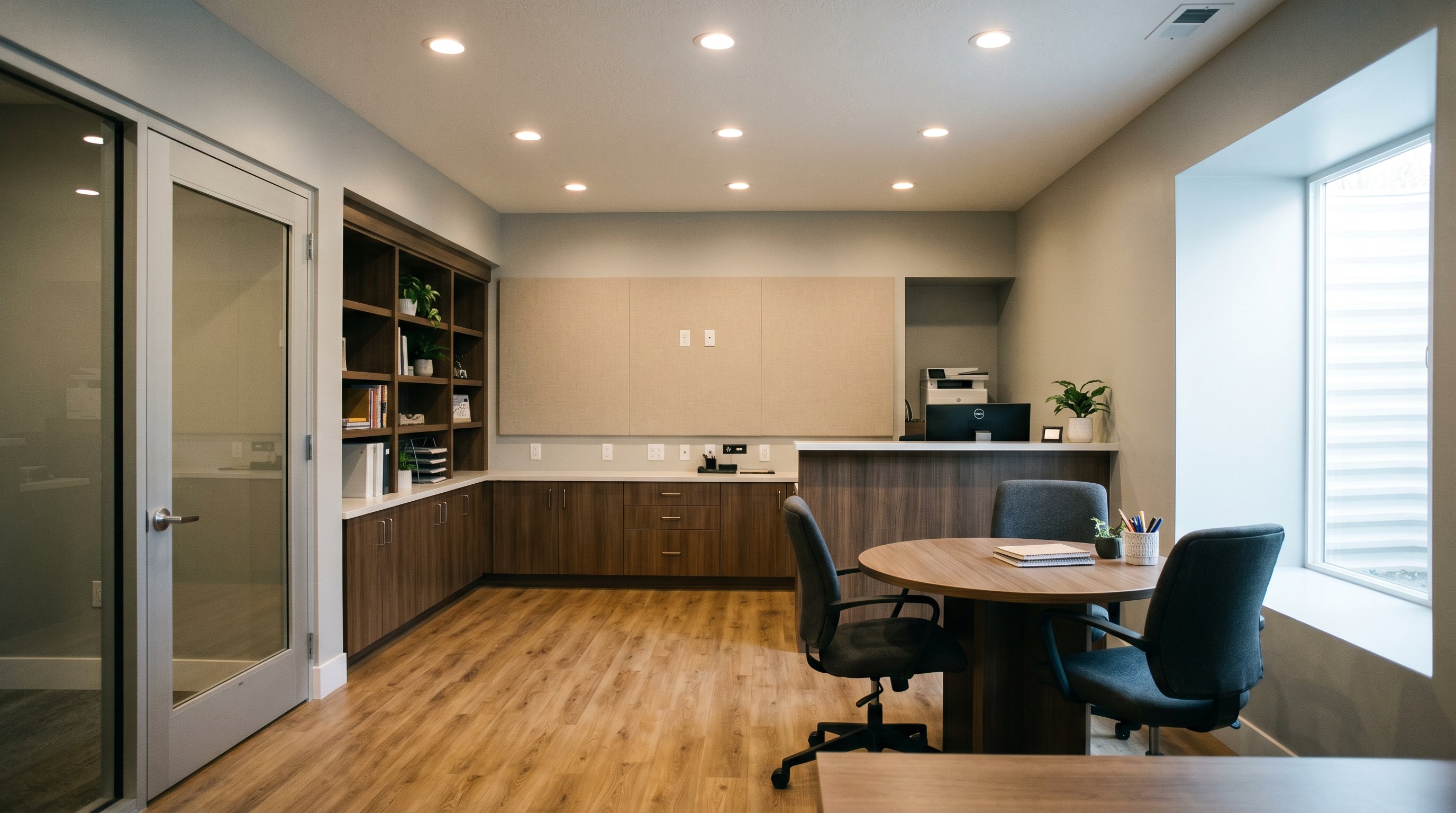
Office renovation projects usually look simple on paper, new walls, better lighting, cleaner finishes. Then the surprises show up. We've walked into spaces in Utah County where a "quick refresh" turned into rerouting HVAC, correcting noncompliant exits, and redesigning traffic flow because staff were crossing paths 200 times a day between reception and workstations. That's why planning matters more than paint colors. In this guide, we'll walk through the decisions that actually shape a successful office renovation in 2026: goals, budget, permits, layout, materials, and construction planning. The aim is simple, build a workspace that works harder every day, without wasting time or money.
Define Your Office Goals, Workflow, And Space Priorities
The clearest wins happen when you define function before design. In our experience, the biggest mistake isn't picking the wrong finish, it's renovating around assumptions instead of daily behavior.
On one recent walkthrough, we counted 14 steps from the printer to the shared files, then watched three employees repeat that trip dozens of times before lunch. That kind of friction adds up. According to a 2024 Gensler workplace survey, high-performing workplaces are far more likely to support both focused work and collaboration in the same footprint. So start by listing what the office must do every day: client meetings, heads-down work, storage, team huddles, private calls, shipping, or reception.
In Utah County, that often means balancing growth with efficiency. A fast-growing office near Lehi or along the Provo-Orem corridor may need flexible rooms that convert as teams expand.
We recommend creating three lists:
- Must-haves: code-required rooms, ADA access, conference space, storage
- Operational pain points: noise bleed, bottlenecks, poor lighting, lack of outlets
- Future priorities: hybrid work zones, brand-forward finishes, scalable workstations
If your company also owns residential investment property, the same planning discipline used in Utah basement finishing applies here: define use first, then build around it. And if you want a contractor who handles both workspace function and long-term durability, our construction team approaches design with that bigger operational picture in mind.
Set A Realistic Budget And Renovation Scope
The number that surprises owners most is usually the "hidden" budget, not finishes, but mechanical, electrical, permitting, and downtime. We've tested enough scopes to know that a realistic budget starts with what you're not seeing yet.
For straightforward remodels, broad 2026 commercial interior renovation costs often land anywhere from $50 to $250 per square foot depending on systems, finish level, and reconfiguration depth, with figures commonly cited by industry sources like JLL and regional contractor benchmarks. A cosmetic update sits at the low end. Moving plumbing, upgrading panels, or rebuilding restrooms pushes the number fast.
We typically break office budgets into five buckets:
- demolition and prep
- construction and trades
- finishes and fixtures
- permits, design, and contingency
- temporary operations costs
And contingency is not optional. We usually advise 10% to 15%. In older spaces, especially tenant improvements, we've uncovered undersized circuits, unpermitted walls, and HVAC distribution that simply didn't match the reflected ceiling plan.
Scope matters just as much as budget. If you're deciding between phased improvements and a full reset, compare the cost of patchwork fixes against one coordinated remodel. The same logic appears in our 2026 ROI guide: investing once, with a plan, usually performs better than repeating small reactive upgrades.
Understand Utah County Permits, Codes, And Building Requirements
This is where projects either stay smooth or get expensive. The moment an inspector flags occupancy, accessibility, or life-safety issues, your timeline can change by weeks.
In Utah County, permit requirements vary by city, but most office renovations trigger review when you alter walls, exits, electrical, plumbing, HVAC, or occupant load. Cities like Provo, Orem, and Lehi each have their own submittal process, while the governing technical standards are generally based on the state-adopted International Building Code, International Existing Building Code, International Mechanical Code, and National Electrical Code through the Utah Uniform Building Standards. Accessibility requirements are also shaped by the ADA Standards.
We've seen one small layout change create three code issues at once: reduced egress clearance, insufficient return air, and a conference room occupant load that required a different door swing. None of those were visible in the inspiration photos.
Before finalizing design, verify:
- occupancy classification
- exit paths and door hardware
- restroom accessibility
- lighting and power loads
- HVAC capacity and ventilation
- fire alarm or sprinkler impacts
That's one reason our Utah renovation work is planned around code review early, not after demolition starts.
Plan A Layout That Supports Productivity And Daily Use
A good office layout should remove friction in plain sight. When the plan is right, people stop noticing the space, and start working better in it.
We test layouts by tracing movement, not just measuring walls. In one office, the owner wanted a larger break room. But after mapping traffic for 30 minutes, it was obvious the bigger problem was acoustic spill from sales calls into admin desks just 11 feet away. Reallocating that square footage into two phone rooms and a shorter circulation path improved daily function more than any lounge upgrade would have.
Research from Harvard Business Review and workplace studies from Leesman consistently show that noise, privacy, and interruption are among the top complaints in underperforming offices. So layout should answer practical questions first:
- Where does focused work happen?
- Where do confidential conversations happen?
- Which teams need line-of-sight collaboration?
- What spaces sit empty most of the week?
For businesses around Utah County, especially in growth-heavy areas near Thanksgiving Point, flexibility matters. Modular conference rooms, shared touchdown spaces, and built-in storage often outperform oversized private offices. Our workspace remodeling projects usually prioritize adjacencies, who needs to be near whom, before aesthetics, because that's where measurable productivity gains usually start.
Choose Durable Finishes, Lighting, And Built-In Features
The materials people touch every day tell you whether a renovation was planned well. We've watched beautiful offices age badly in 18 months because the finish schedule looked good but ignored maintenance, glare, and wear patterns.
For 2026, durable usually beats trendy. Commercial-grade LVP, high-pressure laminate cabinetry, acoustic wall panels, and washable low-sheen paint all hold up well in busy offices. In entry zones, we like walk-off systems that capture moisture and dust before it spreads: according to ISSA cleaning data, proper matting can remove a significant portion of tracked-in soil and reduce floor wear.
Lighting deserves the same discipline. The Illuminating Engineering Society notes that poor light uniformity and glare contribute to visual fatigue. We aim for layered lighting: ambient fixtures, task lighting where needed, and warmer accents in reception or client-facing areas.
Built-ins also earn their keep. Storage walls, banquettes, printer niches, and integrated charging stations reduce clutter without stealing floor area. That same custom-thinking drives our basement build-outs and older lower-level remodels: durable materials and built-in function almost always outperform decorative extras.
Prepare For Construction, Scheduling, And Business Disruptions
The biggest transformation during renovation is often invisible: a chaotic project becomes manageable once sequencing is clear. That shift matters because disruption, not design, is what most owners fear.
For a standard office renovation, construction can take anywhere from 6 to 16 weeks depending on permitting, inspections, long-lead materials, and whether the business stays open during work. We've found the smoothest projects are phased before demolition starts: who moves where, what happens to IT, when noisy work occurs, and how dust control will be handled.
In active offices, we typically plan for:
- temporary work zones or remote days
- after-hours demolition for high-noise tasks
- protected paths for staff and clients
- weekly progress updates with look-ahead scheduling
- early ordering of lighting, glass, doors, and millwork
That communication piece sounds basic, but it saves projects. The Construction Industry Institute has long linked front-end planning to better cost and schedule performance. Around American Fork and greater Utah County, winter weather can also affect deliveries and exterior access, so schedule buffers are smart, not pessimistic.
Whether we're handling an office or a finished lower level, the same rule applies: the cleaner the plan, the less the disruption.
Conclusion
A successful office renovation isn't just a visual upgrade. It's a workflow decision, a code decision, and a long-term operating decision. When we plan projects in Utah County, we focus on the parts that owners feel every day, movement, light, durability, compliance, and disruption control. Get those right, and the finished office won't just look better in 2026. It'll work better too.