
Weber County ADU Builds That Add Real Property Value In 2026
Meta title: Weber County ADU Builds: Add Value in 2026
Meta description: Weber County ADU builds can raise value, create rental income, and improve flexibility. Here's what boosts ROI most in 2026.
A surprising number catches homeowners off guard: the right ADU can do more than add square footage, it can change how a property competes in the market. We've walked Weber County homes where an unfinished basement felt cold, dim, and underused, then watched that same footprint become a code-compliant apartment that appraisers, renters, and buyers immediately understood. In 2026, with housing pressure still high across Utah, accessory dwelling units aren't a trend piece. They're a practical value play, if they're designed, permitted, and built with local reality in mind.
Why ADUs Are Becoming A Smart Investment In Weber County
The short answer: Weber County ADUs solve two expensive problems at once, housing demand and wasted space.
We keep seeing the same turning point during homeowner consultations. Someone walks us through a basement near Ogden or North Ogden, points to 900 or 1,200 unfinished square feet, and says, "We're paying for this space already. Why isn't it working harder?" That's the right question. Utah's housing market still favors flexible properties, and an ADU gives owners options: long-term rental income, housing for parents, or a private setup for adult kids.
The market backdrop matters. According to the Kem C. Gardner Policy Institute, Utah has faced a persistent housing shortage for years, which supports demand for smaller, independent living spaces. At the same time, the U.S. Census Bureau continues to show Utah among the nation's fastest-growing states. More people, tighter housing supply, and rising mortgage pressure make legal secondary units more attractive.
From our side of the jobsite, the smartest projects start with utility, not hype. A well-planned basement apartment or detached unit often outperforms flashy remodels because it creates a recognizable use case. That's one reason our ADU builds and broader construction services are increasingly centered on flexible, income-capable spaces.
How An Accessory Dwelling Unit Increases Home Value
An accessory dwelling unit increases value by adding usable living area, income potential, and buyer flexibility, not just by adding walls.
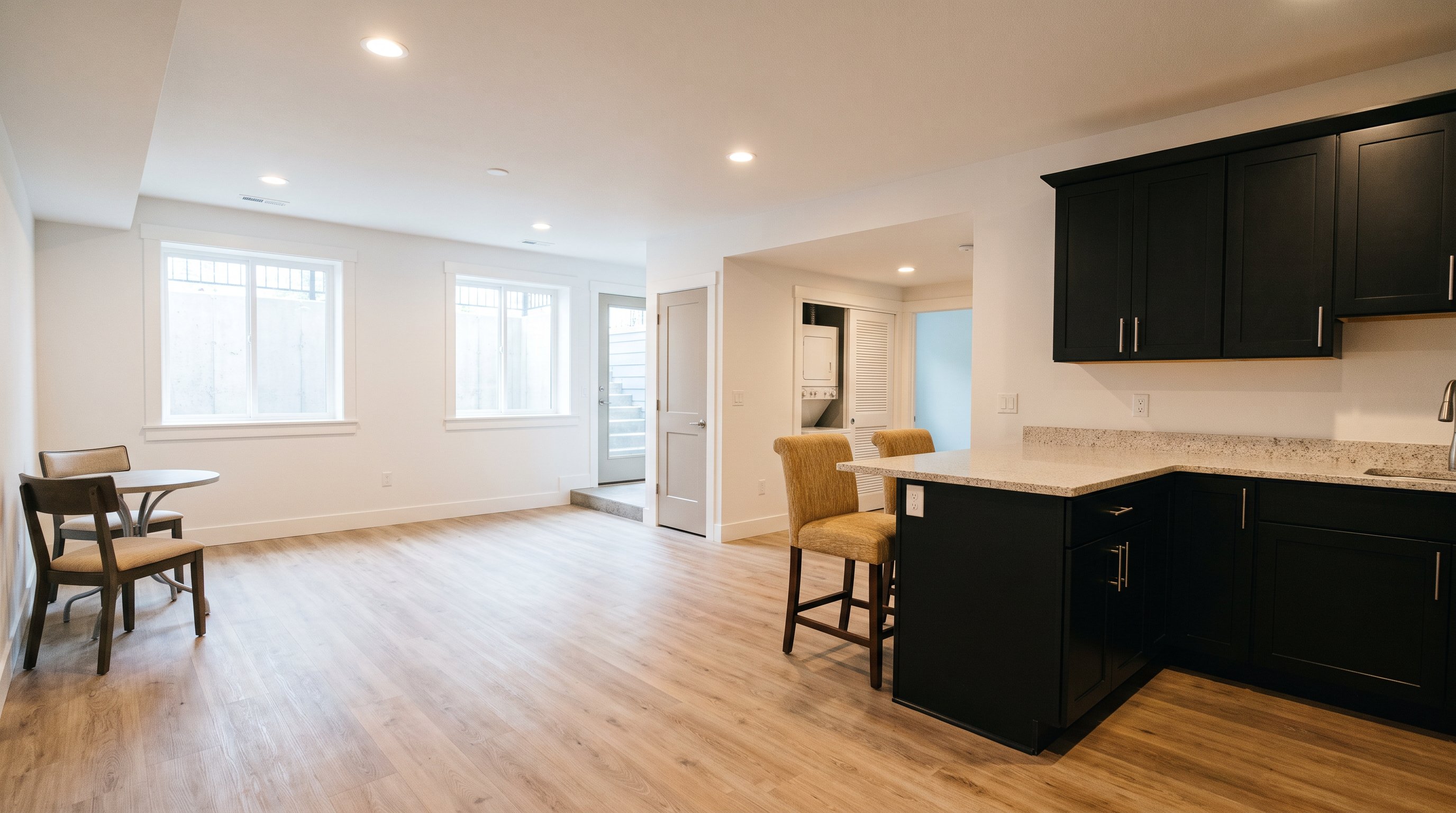
Here's the distinction that matters. A basement finish with a couch and TV is nice. A self-contained ADU with a kitchen, bathroom, laundry, storage, and proper egress tells a buyer exactly what they're getting. That clarity raises perceived value. In our experience, buyers don't just count square feet: they price in independence.
There's also evidence behind the intuition. Freddie Mac notes that ADUs can contribute value through rental income and marketability, particularly where affordable housing is constrained. Fannie Mae likewise allows appraisers to consider ADU features and, in some cases, income characteristics when supported by the market.
On recent Utah projects, we've seen the biggest lift when the unit feels intentional rather than improvised. Separate entrances, full-height finishes, and sound control between levels consistently matter more than oversized decorative upgrades. If you're converting an existing lower level, our basement remodeling approach usually starts with one blunt question: would a stranger pay to live here for a year? If the answer is yes, the market usually notices too.
The Weber County Factors That Influence ADU Return On Investment
The biggest ROI drivers in Weber County are code compliance, neighborhood fit, moisture control, and the quality of the layout.
This is where local knowledge saves money. Along the Wasatch Front, we routinely inspect for foundation settling, slab movement, and moisture before we frame anything. That matters because a beautiful ADU with hidden water intrusion can lose value fast. We've opened basement walls and found minor cracking near window wells or cold-joint seepage, issues that were fixable early but expensive later.
Location inside Weber County changes the equation too. A home near downtown Ogden, Weber State University, or commuter routes may have stronger rental appeal than a layout that's harder to access or park at. Detached units can shine on larger lots, while basement ADUs often make more financial sense in established neighborhoods where the shell already exists. The Weber County Community Development process and local city rules also shape what's feasible, from setbacks to owner-occupancy requirements.
We advise owners to weigh ROI against project type. Reworking an existing basement is often more cost-efficient than a ground-up structure because core framing, roofing, and foundation are already there. For homeowners comparing attached and detached options, our detached unit work becomes especially valuable when privacy and long-term flexibility outweigh initial cost.
Design Choices That Make An ADU More Valuable
The most valuable ADUs feel bright, durable, and easy to maintain from day one.
The surprise for many homeowners is that "luxury" in an ADU doesn't always mean expensive stone everywhere. It means smart, resilient choices. In Weber County, we lean toward LVP or engineered hardwood because Utah's dry air, snow, and temperature swings are rough on solid wood. We also prioritize layered lighting, taller-feeling trim details, and storage built into awkward basement zones, including the concrete cold storage rooms so common under Utah porches.
We've tested finishes across occupied remodels, and the units that age best share a few traits: easy-clean shower surrounds, quartz or quality solid-surface counters, durable cabinet boxes, and excellent ventilation. According to the National Association of Home Builders, storage, energy efficiency, and practical layouts consistently rank high with buyers.
A separate entrance is often the single highest-impact design move. After that, acoustical separation matters more than people expect. Dense insulation, strategic mechanical placement, and solid-core doors can be the difference between "finished basement" and "real apartment."
Features Buyers And Renters Notice Most
The features people comment on first are usually the ones that improve privacy and daily comfort.
In walkthroughs, renters notice five things within about 30 seconds: natural light, ceiling height, kitchen function, bathroom quality, and noise. Buyers notice many of the same items, but they also look for future adaptability. A 24-inch range and apartment fridge can work, yet a full-size laundry setup and genuine pantry storage tend to make the unit feel permanent.
We've also found that code-driven features become selling features when executed well. Egress windows, for example, are required for basement bedrooms, but they also bring in dramatically more daylight. On one lower-level conversion, cutting in two oversized egress windows changed the room from cave-like to lease-ready in a week. For homeowners wanting broader lifestyle upgrades under one roof, our remodeling capabilities reflect the same principle: practical function first, then polish.
Planning, Permits, And Budget Decisions That Protect Your Value
The safest way to protect ADU value is to plan for code, inspections, and realistic costs before demo starts.
We've seen the costly version of this story: a homeowner gets excited, frames a bedroom, adds a hot plate, and assumes they can "sort out permits later." Then the city asks for revised electrical, plumbing, ceiling height, or egress details, and the budget gets hit twice. Done properly, the process is slower at the front end and cheaper at the back end.
For Utah homeowners, permits aren't busywork. They're how you preserve resale credibility and avoid insurance or appraisal headaches. The International Residential Code and local amendments govern essentials like fire separation, stairs, smoke alarms, ventilation, and bedroom egress. In our projects, we handle permitting and build around inspection milestones so owners always know the next phase.
Budget discipline matters just as much. For 2024–2026 Utah basements under 1,000 square feet, our historical average has landed around $52 to $73 per square foot, with plumbing-heavy remodels running higher. Standard basement timelines typically range from 8 to 14 weeks, depending on scope and permit turnaround. Transparent scopes, weekly updates, and 3D design mockups don't just reduce stress, they help keep ROI intact.
Conclusion
The best Weber County ADU builds add value because they answer real housing needs with clean design, solid construction, and local code knowledge. In Weber County, the winning projects aren't the flashiest, they're the ones that feel legal, livable, and durable from the first walkthrough. If we were advising a homeowner today, we'd start with feasibility, moisture and structure, then design for privacy, light, and long-term use.